


Enviropol Engineers Gains Control Over Multi-Site Project Logistics with 93% On-Time Vehicle Placement and 11% Freight Cost Savings
Case Study Enviropol Engineers Gains Control Over Multi-Site Project Logistics with 93% On-Time Vehicle Placement












Case Study Enviropol Engineers Gains Control Over Multi-Site Project Logistics with 93% On-Time Vehicle Placement
Table of Content : Two steel plants of roughly the same size, making roughly the same products, can
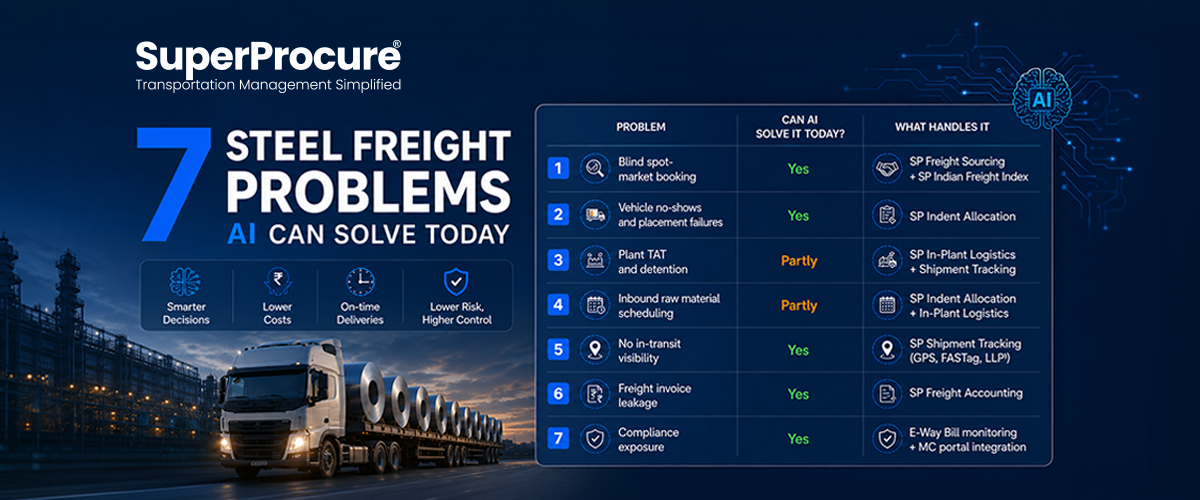
There is a version of this article that lists seven problems and claims artificial intelligence solves all of them. It would be easier to write and it would be wrong, and anyone running a steel plant would spot it by the second heading.
So this is the honest version. Seven problems that show up in every metal and steel freight operation in India, and for each one, a straight answer about what software can do about it today. Some are genuinely solved. Some are partly solved, which usually means the technology works but the surrounding process has to change too. And some are not software problems at all, which is worth saying out loud in a market where every vendor is promising AI will fix everything.
In one line: Of the seven core freight problems in steel logistics, five can be substantially solved today with an AI-native TMS — blind spot booking, vehicle no-shows, in-transit blindness, invoice leakage and compliance exposure. Plant TAT and inbound scheduling are partly solvable. Structural constraints like road quality and rake availability are not software problems.
Key Takeaways
| Problem | Can AI solve it today? | What handles it |
|---|---|---|
| 1. Blind spot-market booking | Yes | SP Freight Sourcing + SP Indian Freight Index |
| 2. Vehicle no-shows and placement failure | Yes | SP Indent Allocation |
| 3. Plant TAT and detention | Partly | SP In-Plant Logistics + Shipment Tracking |
| 4. Inbound raw material scheduling | Partly | SP Indent Allocation + In-Plant Logistics |
| 5. No in-transit visibility | Yes | SP Shipment Tracking (GPS, FASTag, ULIP) |
| 6. Freight invoice leakage | Yes | SP Freight Accounting |
| 7. Compliance exposure | Yes | E-Way Bill monitoring + NIC portal integration |
A contracted transporter cannot place a vehicle, so someone calls the spot market at four in the afternoon with a load that has to move tonight. The market can hear the urgency. Whatever rate comes back gets accepted, because the alternative is a missed dispatch, and nobody in the room has any way of knowing whether that number was fair.
This is a pure information problem, which is why it is solvable. Two things fix it: competition, and a benchmark. SP Freight Sourcing runs the requirement as a competitive digital auction to your whole carrier pool at once rather than a sequence of phone calls, and the SP Indian Freight Index gives a live market reference for the lane so a quote can be judged instead of accepted. Carrier recommendations ranked on actual past performance mean you are not just buying the cheapest number from someone who may not turn up.
Verdict: solved today. This is among the most straightforwardly addressable problems in steel freight, and it is usually where the fastest cost recovery shows up.
An indent goes out, a transporter accepts, and at nine the next morning there is no truck. Sometimes there is a call, often there isn’t. The load is now late and the replacement will come from the spot market at a premium, which means problem two quietly turns into problem one.
What makes this expensive is not the refusal itself. It is the hours between the refusal and somebody noticing. SP Indent Allocation closes that gap by reassigning automatically to the next transporter in the configured sequence rather than waiting for a human to spot the gap, and computing penalties on non-performance without anyone having to build a case at month end. Where a response window lapses entirely, the requirement escalates to spot sourcing on its own.
Verdict: solved today. SuperProcure customers report 97% on-time vehicle placement, and the mechanism is unglamorous — the system stops waiting for people to notice.
A vehicle enters the gate in the morning and leaves in the afternoon, having been loaded for forty minutes. The rest was queueing at the weighbridge, parked in the yard, and waiting for a bay. Transporters who know your plant runs long simply price it into their rates, so you pay for the delay permanently and never see it as a charge.
Technology genuinely helps here, and it helps by removing surprise. If the platform knows which vehicles are approaching and when, the plant can sequence the weighbridge, allocate bays and stage material in advance instead of reacting at the gate. SP In-Plant Logistics tracks each vehicle through gate, weighbridge, yard and loading so the time between stages is measured rather than assumed, which is also how the long tail finally becomes visible.
Verdict: partly solved. The scheduling and measurement are available today, and customers have improved plant TAT by up to 80%. But this one needs the plant to change how it works, not just what it watches. If the yard team keeps loading in arrival order regardless of what the schedule says, the software will document the problem beautifully and change nothing.
Most steel plants run a tight outbound operation and a much looser inbound one, despite coal, ore, scrap and limestone often carrying comparable or greater tonnage. Inbound arrives from scattered sources against a furnace schedule that cannot be moved, and it is frequently coordinated over phone calls between three parties who each have partial information.
The same allocation and visibility logic applies to inbound as outbound, which is the useful insight. Auto-reassignment and live tracking work identically regardless of direction, and load building improves what goes on each vehicle. Once inbound sits on the same platform, the plant can finally see both halves of its freight against one schedule.
Verdict: partly solved. The technology transfers cleanly, but inbound often involves suppliers and modes the plant does not control, including rail rakes and mine dispatch schedules. Software can coordinate what it can see. It cannot conjure a rake.
The customer calls asking when material will arrive. Your team calls the transporter, who calls the driver, who is somewhere on a highway with a rough sense of the situation. Twenty minutes later a number gets passed back up the chain, and everyone treats it as fact despite its origin.
This is comprehensively solved, and India is unusually well positioned because of ULIP, the government API layer that aggregates FASTag, Vahan and Sarathi data. SP Shipment Tracking uses GPS along with that integration, which means location and compliance status are verified against government data rather than driver self-reporting. Predicted arrival times replace guesses, and downstream planning becomes possible — which, not incidentally, is what makes problem three solvable at all.
Verdict: solved today. Of all seven, this is the one where the gap between an unequipped and an equipped operation is most stark.
At high dispatch volumes the invoices get messy. Rate mismatches, wrong weights, detention charges nobody approved, duplicate billing on split loads. A finance team checking hundreds of bills manually will miss some, and what gets missed gets paid. Each error is small enough to be uninteresting. The annual total is not.
Anomaly detection is one of the things machine learning is genuinely good at, because the task is pattern recognition against a known baseline. SP Freight Accounting checks every bill against the agreed rate, weight and route before payment and surfaces the discrepancies and applicable SLA deductions while there is still time to act. Finance stops discovering leakage at month end because the system catches it at invoice time.
Verdict: solved today. And it is the problem with the cleanest measurable payback, because the recovered amount is directly countable.
An e-way bill expires while the truck is still moving, because a weighbridge queue and a road blockage added six hours nobody planned for. The driver does not watch expiry timestamps. The first person to notice is an official at a state border, and by then the penalty and the detention are both already happening.
This is a monitoring problem, and monitoring is exactly what a connected platform does well. SuperProcure fetches e-way bill data from the government portal and notifies in advance of expiry, so there is time to extend rather than a discovery after the fact. Ship To GSTIN is captured at the indent stage so the bill is complete when generated. And on unloading confirmation, the platform can close the e-way bill through an API request rather than relying on someone to remember.
Verdict: solved today, with the caveat that compliance rules change and the system has to keep pace with them.
Some of what makes Indian steel logistics hard is not a software problem, and pretending otherwise damages your ability to plan.
The reason to state this plainly is that it makes the rest of the claims believable. A vendor who admits the boundary is more trustworthy on what sits inside it.
The problems compound, which is the part most plants underestimate. Blind sourcing gets worse when placement is unreliable. Placement gets worse when nobody can see the truck. Solve them in isolation and you keep rediscovering the same cost in a different department.
The reason one platform matters here is that these problems are connected. Fixing sourcing while leaving allocation manual just moves the failure downstream. SuperProcure runs the whole lifecycle — sourcing, allocation, in-plant movement, tracking, proof of delivery and freight settlement — on a single system that transporters use too, which is what makes the data complete enough for the intelligence to be worth anything.
That is the practical meaning of AI-native. Not a model bolted onto a records system, but a platform where the intelligence can see across the whole operation and act on it: benchmarking a rate, reassigning a refused indent, predicting an arrival, flagging an invoice, watching an expiry clock.
Freight cost savings
On-time vehicle placement
Lower plant TAT
ETA prediction accuracy
Source: SuperProcure — Metal & Steel Industry, verified performance metrics
Metal and steel companies working with SuperProcure include Shyam Steel, Shyam Metalics, Goodluck, APL Apollo, Hindalco, Sunflag Iron & Steel and Hansa Metallics.
“SuperProcure has simplified our logistics operations tremendously. With complete visibility of both dedicated and sourced vehicles on one platform, monitoring has become effortless.”
Hansin Garg, Director, Hansa Metallics Limited
Read the full case study: superprocure.com/case-studies/hansa-metallics-metal-supply-chain-case-study
Take the seven and mark each one honestly as solved, partly handled, or not addressed at your plant today. The exercise is more useful than it sounds, because most operations discover they are strong on the two problems that get management attention and weak on the three that quietly cost the most.
Then start with whichever of the solvable five is worst, not with the one that is most discussed. The compounding works in your favour too. Fix visibility and plant TAT becomes easier. Fix placement and the spot premium shrinks on its own.
• SuperProcure — Metal & Steel Industry (platform performance metrics)
• SuperProcure — Hansa Metallics case study
• SuperProcure — company overview and customer base
• Unified Logistics Interface Platform (ULIP) — official portal
• Press Information Bureau, Govt. of India — organisations with ULIP data access (SuperProcure listed)
See Which of the Seven SuperProcure Solves for Your Plant Book a Demo