


Enviropol Engineers Gains Control Over Multi-Site Project Logistics with 93% On-Time Vehicle Placement and 11% Freight Cost Savings
Case Study Enviropol Engineers Gains Control Over Multi-Site Project Logistics with 93% On-Time Vehicle Placement












Case Study Enviropol Engineers Gains Control Over Multi-Site Project Logistics with 93% On-Time Vehicle Placement
Table of Content : Two steel plants of roughly the same size, making roughly the same products, can
Every logistics conference in 2025 had the same slide: a robot moving boxes under the caption “The Future of Logistics Is AI.” Every software vendor had an AI roadmap. Every press release mentioned machine learning.
And yet, when you ask a VP Logistics at a large Indian manufacturer what AI is actually doing for their freight operations today, the honest answer is usually: not much yet. Not because AI isn’t relevant it absolutely is but because most of the AI conversation in logistics is about future capabilities, not present ones.
This blog cuts through the noise. It explains the three AI capabilities running in freight sourcing today (not on a roadmap), what separates an AI-native TMS from AI bolted onto legacy software, and why SuperProcure is built as logistics intelligence in production — not a TMS with an AI label added later.
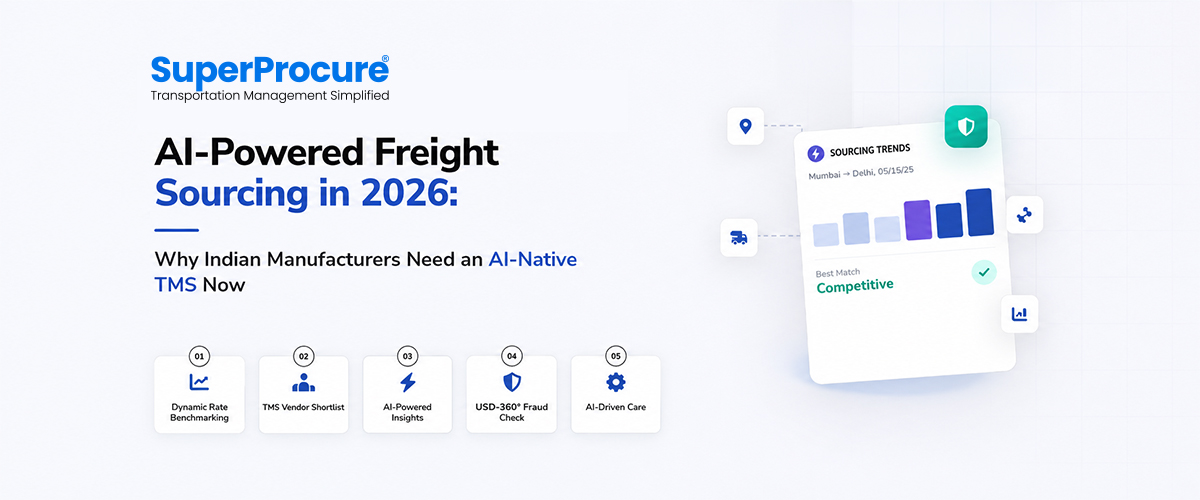
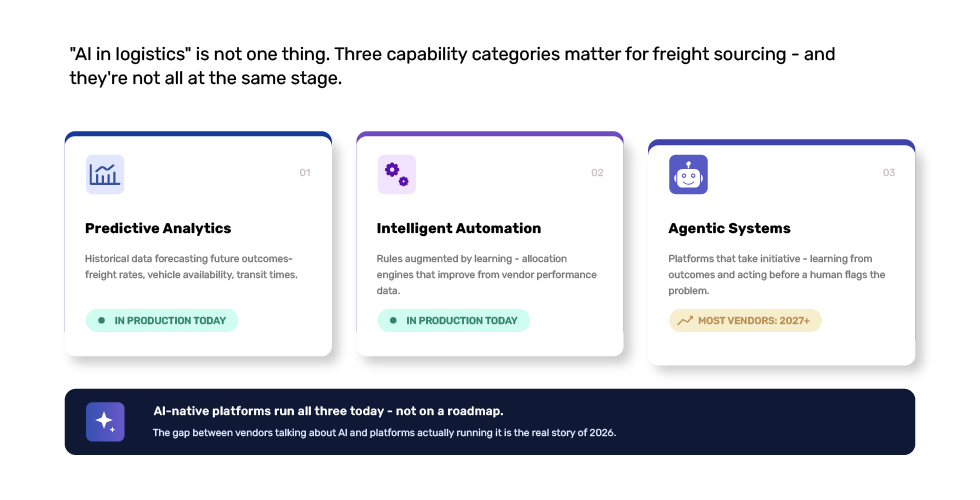
Let’s start with a definition, because “AI in logistics” is not one thing. It ranges from simple rule-based automation to machine learning models that predict future outcomes from historical patterns. In 2026, the AI capabilities most relevant to freight sourcing fall into three categories:
The third category — agentic AI in logistics — is what most TMS vendors are still promising for 2027 and beyond. But the first two are already in production, and AI-native platforms are running all three today rather than waiting for a roadmap to catch up. That gap — between vendors talking about AI and platforms actually running it — is the real story of 2026.
Freight rates in India are not static. They move with diesel prices, seasonal demand from agriculture and construction, monsoon disruptions on key corridors, and macro factors affecting carrier availability. A logistics head negotiating annual rate contracts without real-time rate intelligence is negotiating blind.
AI-driven rate benchmarking uses historical transaction data from thousands of loads on the same route and vehicle type to answer one question: is the rate you’re being offered competitive or not? With enough data, it predicts rate direction — signalling whether to lock contract rates now or wait for softening.
SuperProcure’s Indian Freight Index — built on live carrier data across geographies, distances, and vehicle types — is exactly this kind of intelligence layer, giving logistics teams a real-time benchmark for every route.
Not all transporters are equal, and the differences that matter aren’t always visible in a rate card. A transporter who bids cheaper but routinely fails to place vehicles is not a better choice than one who bids slightly higher and places reliably on time.
ML-enhanced vendor scoring builds a performance profile for every transporter from actual transaction history: bid-to-placement ratio, on-time arrival, deviation from bid price at invoicing, documentation compliance, response time. That score weights allocation — strong performers move up the queue, weak ones move down.
The most operationally powerful AI capability in freight sourcing is the platform acting on its own signals — taking the next step automatically when conditions are met. This is where AI-native shows up most visibly: the system thinks, decides, and acts in the same loop.
Running in production today:
This is exactly what SP Indent Allocation’s automated reassignment delivers today — the platform handling the exception, not your team chasing it.
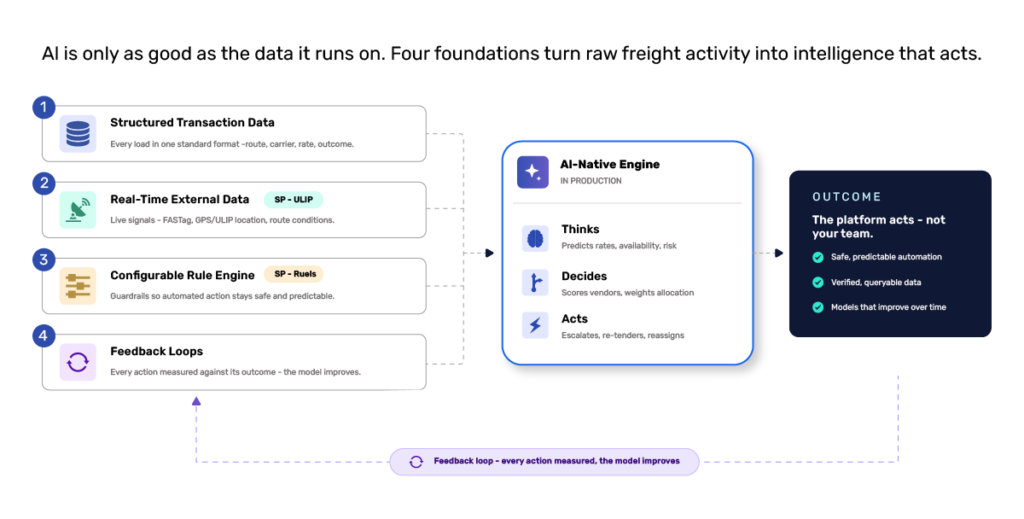
AI is only as good as the data it runs on. A TMS that doesn’t capture structured, reliable transaction data cannot support meaningful AI. AI-ready infrastructure requires four things:
India has a logistics-AI advantage that’s often underappreciated: the Unified Logistics Interface Platform (ULIP) — a government-built API layer aggregating real-time data from FASTag (toll and location), Vahan (vehicle registration and compliance), Sarathi (driver-licence validation), and other transport databases.
For a TMS integrated with ULIP, every shipment carries a real-time data stream: where the vehicle is, whether the driver’s licence is valid, whether the truck passed fitness certification — the ground-truth data that makes AI predictions accurate rather than theoretical.
SuperProcure’s live ULIP integration means SP’s shipment tracking doesn’t depend on driver self-reporting — it’s verified against government data, so every SP transaction builds a verified dataset.
SuperProcure is an AI-native TMS — built so intelligence runs at the core of the platform, not bolted on as a late afterthought. That distinction is the whole game: a platform architected around AI can act on its data; legacy software with a model attached can only report on it.
SP’s foundation is what makes the intelligence real: a structured transaction database built from thousands of auctions across 300+ enterprise customers; live ULIP API integration; a configurable rules engine that lets the platform act safely; and a multi-enterprise collaboration layer capturing performance data across shippers, carriers, and customers. This is logistics intelligence in production — thinking, deciding, and acting across freight operations.
The vendors still promising AI for 2027 are working to retrofit it onto platforms built around manual workflows and spreadsheet exports. That’s the hard way. AI-native means the platform was built for this from the start.
Five questions that separate genuine capability from marketing claims:
SuperProcure answers yes to all five. That’s what AI-native looks like in practice.
The AI transformation of Indian logistics isn’t arriving in 2028. The dividing line is already here in 2026 — between vendors talking about AI on a roadmap, and platforms running logistics intelligence in production.
Indian manufacturers who want the benefit of AI don’t need to wait for a product launch or a platform rebuild. They need a TMS built AI-native from the start — one that thinks, decides, and acts across their freight operations today.
That’s what SuperProcure is. Not a TMS with AI added on. An AI-native platform, with the intelligence already in production.
See how an AI-native TMS helps enterprise manufacturers automate freight sourcing, benchmark market rates in real time, and make faster, data-driven logistics decisions using capabilities already running in production.