


Enviropol Engineers Gains Control Over Multi-Site Project Logistics with 93% On-Time Vehicle Placement and 11% Freight Cost Savings
Case Study Enviropol Engineers Gains Control Over Multi-Site Project Logistics with 93% On-Time Vehicle Placement












Case Study Enviropol Engineers Gains Control Over Multi-Site Project Logistics with 93% On-Time Vehicle Placement
Table of Content : Two steel plants of roughly the same size, making roughly the same products, can
Two steel plants of roughly the same size, making roughly the same products, can run their logistics in completely different centuries. One dispatches on the strength of a logistics manager who knows every transporter by name and keeps the real plan in a notebook. The other runs the same volume with fewer people, better rates, and a system that reassigns a load before anyone has noticed the truck isn’t coming.
The gap between them is not budget. It is maturity. And most plants have never actually located themselves on that curve, which makes it very hard to know what to fix next.
This is a five-level model for doing exactly that. It is written specifically for metal and steel operations, because the sequence of problems in this industry is distinctive: inbound raw material and outbound dispatch behave like two different businesses, plant TAT is a bigger cost than most CFOs realise, and freight settlement volumes are high enough that small errors compound quickly.
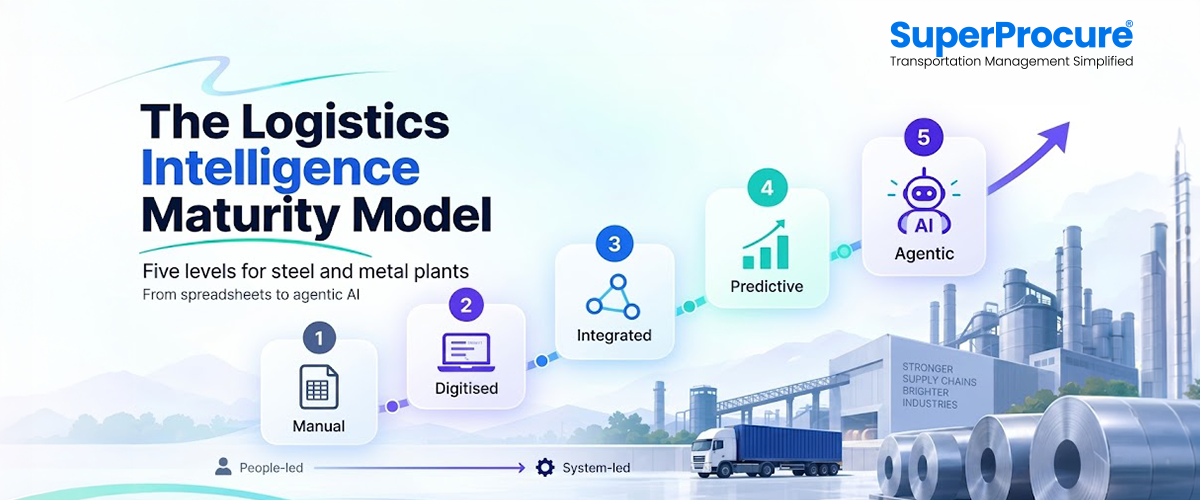
In one line: The Logistics Intelligence Maturity Model describes five stages a steel plant’s freight operation moves through — Manual, Digitised, Integrated, Predictive and Agentic — defined by how much of the decision-making the system does rather than the people.
Key Takeaways
It is tempting to measure progress by what you have bought. An ERP, a tracking app, a rate spreadsheet with pivot tables that only one person understands. But tools do not determine maturity. What determines it is how many decisions the system makes without a human in the loop.
A plant with three logistics tools where every decision still routes through a WhatsApp group is less mature than a plant with one platform that reassigns loads on its own. The question is not what you own. It is what happens when a transporter refuses an indent at 8pm on a Saturday.
Every level in this model is defined by the same question, asked at increasing difficulty: when something goes wrong, does a person have to notice first?
| Level | What it looks like | Who decides |
|---|---|---|
| 1. Manual | Freight sourced by phone and WhatsApp. Rates in spreadsheets. Plant TAT known anecdotally. Records written after the event. | People, entirely |
| 2. Digitised | Indents and rates recorded in systems. Some GPS tracking. Data exists but sits in separate places. Reporting is retrospective. | People, with better records |
| 3. Integrated | One platform across sourcing, allocation, in-plant and settlement. Transporters on the same system. Status is live, not requested. | People, with real-time facts |
| 4. Predictive | System forecasts arrival times, rate direction and vendor reliability. Flags problems before they land. Recommends the action. | System advises, people approve |
| 5. Agentic | System acts within set rules: reassigns, escalates, reschedules, computes penalties. Humans handle exceptions only. | System decides, people govern |
Everything works because someone remembers. Sourcing is a round of calls to four transporters, the rate is whatever the third one said, and the record of it exists in a spreadsheet updated when there’s time. Plant TAT is discussed rather than measured. Freight bills are checked in batches at month end, when disputes are already stale.
The tell is not the absence of software. It is that if your logistics manager took two weeks of leave, nobody could reconstruct why last month’s freight cost what it did.
Records now exist in systems rather than notebooks. Indents are raised in the ERP, there’s a GPS app, rates live in a shared sheet. This feels like progress and it is, but the data sits in separate silos that don’t talk. You can produce a report explaining what happened last week. You still cannot act on what is happening this afternoon.
Most Indian steel plants are here, or somewhere between here and Level 1. The frustration at this stage is real: you have invested in tools and the problems haven’t gone away.
This is the jump that changes the economics, and it is less about intelligence than about connection. Sourcing, allocation, in-plant movement, tracking and freight settlement run on one platform. Crucially, transporters are on it too, which means status stops being something you phone someone to obtain.
At this level the invisible costs become visible for the first time. Stage-wise plant TAT. Which transporters actually place versus which ones promise. Where the spot premium is being paid. You cannot fix what you cannot see, and Level 3 is where you start seeing.
Once the data is connected and clean, forecasting becomes possible. The system tells you which trucks will actually reach the plant in the next four hours, which transporter is likely to fail on tomorrow’s indent, whether the rate you’re being quoted is above or below the live market. The work shifts from chasing information to acting on it.
The distinguishing feature of Level 4 is that problems announce themselves before they arrive. A delay surfaces while there is still time to reschedule the bay rather than after the truck is idling in the yard.
At the top of the curve, the system does not just predict and recommend. It acts. Within rules you set, it reassigns a refused indent to the next transporter, escalates to spot sourcing when a response window lapses, recomputes penalties on non-performance, and adjusts the plant schedule when an ETA slips.
People are still very much involved, but their job changes. Instead of running the routine, they govern the rules and handle the genuine exceptions. This is what an AI-native platform makes possible, and it is worth being precise about what is real today: rule-bound autonomous action across sourcing, allocation, in-plant and settlement is in production now. Fully self-directing procurement, where the system sets its own objectives, is not, and anyone telling you otherwise is selling a roadmap.
Six questions, answered without generosity:
Most plants score unevenly, and that is normal. A plant can be Level 3 on outbound dispatch and Level 1 on inbound raw material, because inbound rarely gets the same attention. The uneven pattern is itself useful information about where the next gain is hiding.
SuperProcure is built to take a metal or steel operation from wherever it currently sits to Levels 3 through 5, and the modules map onto the curve fairly directly.
The Level 3 integration comes from running the lifecycle on one platform: SP Freight Sourcing for competitive digital sourcing, SP Indent Allocation for allocation and auto-reassignment, SP In-Plant Logistics for movement inside the plant, SP Shipment Tracking for the journey, and SP Freight Accounting for settlement. Transporters operate on the same platform rather than at the end of a phone line, which is what makes the data complete enough to be useful.
Level 4 comes from what that connected data enables. Live ETAs from GPS, FASTag and ULIP integration instead of driver self-reporting. Rate benchmarking through the SP Indian Freight Index so a quote can be judged rather than accepted. Carrier recommendations ranked on actual placement history rather than reputation.
Level 5 is where the platform starts acting on its own. Auto-reassignment when a transporter refuses. Automatic penalty debits on non-performance. Escalation to spot sourcing when a response window closes. These run inside the guardrails you configure, which is what makes autonomy safe rather than alarming.
Improved plant TAT
On-time vehicle placement
Freight cost reduction
Faster vehicle finalisation
Source: SuperProcure — Metal & Steel Industry, verified performance metrics
Delivered results across SuperProcure’s enterprise customer base of 300+ manufacturers.
Metal and steel companies working with SuperProcure include Shyam Steel, Shyam Metalics, Goodluck, APL Apollo, Hindalco, Sunflag Iron & Steel and Hansa Metallics.
The returns are not evenly distributed, which matters when you are deciding where to spend effort.
Getting from Level 1 to Level 2 mostly buys you better hindsight. Useful, not transformative. The genuinely large gain is Level 2 to Level 3, because that is where hidden costs become visible and where the same team starts handling more volume without more people. Level 3 to 4 converts visibility into foresight, which is where placement reliability and rate discipline improve. Level 4 to 5 is where headcount stops scaling with tonnage, because routine decisions no longer need a human.
Plants that try to leap from Level 1 to Level 5 usually fail, because autonomy without clean data is just fast mistakes. The order matters more than the speed.
Score yourself against the six questions, and do it with the logistics team in the room rather than alone, because the answers tend to differ depending on who you ask. That disagreement is usually the most informative part of the exercise.
Then pick the single weakest link rather than attempting the whole curve. For most steel plants that turns out to be inbound raw material scheduling or stage-wise plant TAT, both of which sit lower on the maturity curve than the dispatch operation everyone watches. The next level is rarely a leap. It is one place where the system starts knowing something before a person tells it.
• SuperProcure — Metal & Steel Industry (platform performance metrics)
• SuperProcure — company overview and customer base
• Unified Logistics Interface Platform (ULIP) — official portal
• Press Information Bureau, Govt. of India — organisations with ULIP data access (SuperProcure listed)
Find Out Where Your Plant Sits Book a SuperProcure Demo