


Enviropol Engineers Gains Control Over Multi-Site Project Logistics with 93% On-Time Vehicle Placement and 11% Freight Cost Savings
Case Study Enviropol Engineers Gains Control Over Multi-Site Project Logistics with 93% On-Time Vehicle Placement












Case Study Enviropol Engineers Gains Control Over Multi-Site Project Logistics with 93% On-Time Vehicle Placement
Table of Content : Two steel plants of roughly the same size, making roughly the same products, can
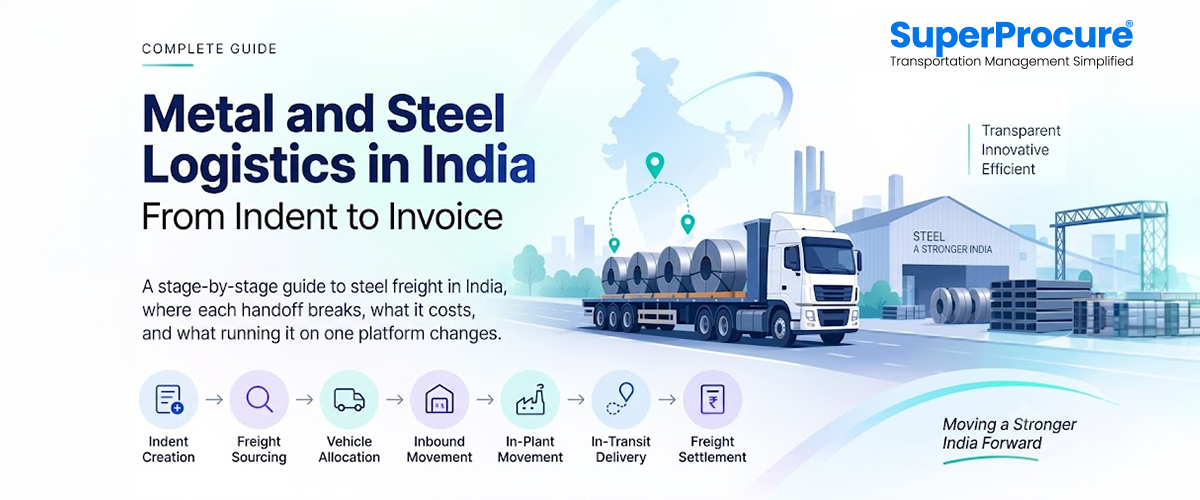
Most conversations about steel logistics start in the middle. Someone wants better rates, or fewer no-shows, or a tracking app, and the discussion narrows to that one thing before anyone has looked at the whole path a load actually travels.
That path is longer than it looks. A consignment of TMT bars leaving a plant in Raipur for a project site in Pune passes through at least seven distinct operational stages, each with its own owner, its own system, and its own way of failing. Coal arriving at the same plant travels an entirely different route through the same organisation. And the freight bill for both gets settled six weeks later by a finance team that had no visibility into either.
This guide walks the full lifecycle, stage by stage. What happens, where it typically breaks, what it costs when it does, and what changes when the whole thing runs on one system instead of seven. It is written for logistics heads, plant heads and supply chain leaders in metal and steel, and it assumes you already know your operation well enough to recognise the failures described.
In one line: The metal and steel freight lifecycle runs through seven stages — indent creation, freight sourcing, vehicle allocation, inbound raw material movement, in-plant movement, in-transit delivery, and freight settlement — and most cost leakage happens in the handoffs between them rather than inside any single stage.
Key Takeaways
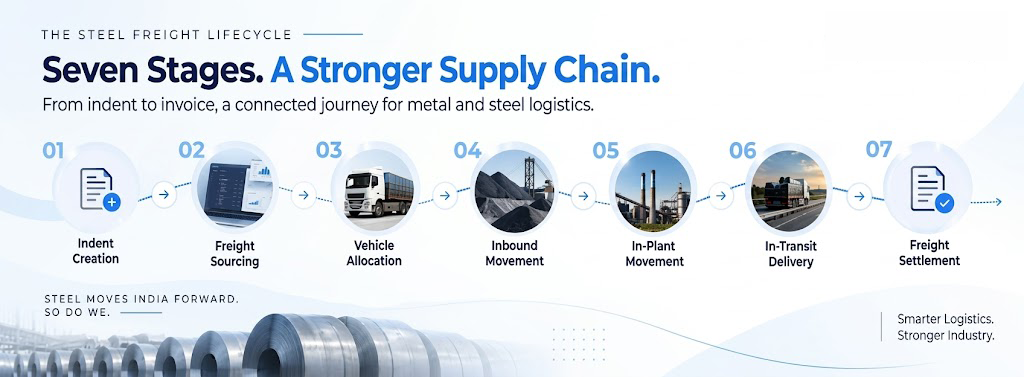
| Stage | What happens | Where it commonly breaks |
|---|---|---|
| 1. Indent creation | Dispatch requirement raised: material, quantity, destination, date | Incomplete data forces rework later; no Ship To GSTIN captured |
| 2. Freight sourcing | Rate discovered and carrier selected for the lane | Phone-based sourcing with no benchmark; spot premium paid blind |
| 3. Vehicle allocation | Load assigned to a transporter, vehicle committed | Transporter refuses and hours pass before anyone notices |
| 4. Inbound movement | Coal, ore, scrap, limestone arrive against furnace schedule | Coordinated on phone calls; rail and road handoffs unsynchronised |
| 5. In-plant movement | Gate, weighbridge, yard, loading bay, exit | Trucks wait for hours; TAT measured as a monthly average or not at all |
| 6. In-transit delivery | Vehicle travels, arrives, unloads, POD captured | Location known only by phoning the driver; e-way bill expires unnoticed |
| 7. Freight settlement | Invoice raised, reconciled, approved, paid | Errors found after payment, or not at all |
Everything downstream inherits the quality of this step. An indent specifies what is moving, how much, where to, by when, and in what kind of vehicle. Get it thin and every later stage pays for it.
The common failure is not laziness, it is that the person raising the indent does not know what later stages will need. Vehicle type gets left generic, so a flatbed turns up for a load that needed a trailer. The Ship To GSTIN is missing, which becomes a compliance problem at stage six rather than a data problem at stage one. Consignee master data is stale, so the address on the paperwork does not match the site the driver is trying to find.
What good looks like is unglamorous: structured capture at the point of creation, with the fields later stages depend on made mandatory rather than optional. Load building matters here too, because deciding what goes on which vehicle at indent stage is far cheaper than rearranging it at the loading bay.
Now the rate gets decided, and this is where the most visible money is won or lost. Contracted lanes run on agreed rates. Everything else goes to spot, and spot is where the discipline usually collapses.
The classic pattern: a load has to move today, someone calls four transporters in sequence, and the third acceptable number gets taken because calling a fifth feels like a waste of an afternoon. There is no benchmark, so nobody in the room can say whether that number was fair. The market can hear urgency and prices accordingly.
Two things fix it. Competition, meaning the requirement goes to your whole carrier pool simultaneously rather than sequentially, so carriers bid against each other instead of against your patience. And a reference rate, so the winning number can be judged against what the lane actually costs. Neither is exotic. Both are simply absent from phone-based sourcing.
A rate is agreed and a transporter commits. Then, sometimes, no truck arrives.
What makes this expensive is rarely the refusal itself. It is the dead time between the refusal and somebody noticing, because that gap is what forces the replacement load into the spot market at a premium. A refusal at 8pm discovered at 9am the next morning has already cost you the good options.
Mature allocation removes the waiting. The load reassigns to the next transporter in a configured sequence automatically. Non-performance gets recorded and penalised as a matter of routine rather than as a case someone has to build at month end. And when nobody responds at all, the requirement escalates to spot sourcing on its own rather than sitting in a queue.
Ask what happens when a transporter refuses an indent at 8pm on a Saturday. The answer tells you more about your logistics maturity than any dashboard.
Here the guide has to fork, because inbound is a genuinely different problem and most plants treat it as a lesser one. Coal, ore, scrap and limestone often carry tonnage comparable to or greater than outbound dispatch, and they arrive against a furnace schedule that cannot be moved.
The difficulty is control. Outbound, you decide when a load leaves. Inbound, you are receiving from scattered suppliers, sometimes across rail and road in the same consignment, on dispatch schedules you influence rather than set. Coordination frequently happens over phone calls between three parties who each hold partial information, and the plant discovers a shortfall when the furnace schedule is already at risk.
The useful insight is that allocation and visibility logic transfers cleanly across direction. Automated reassignment and live tracking work the same whether a truck is arriving or leaving. What does not transfer is control over rail rake allocation and mine dispatch, which stay outside the plant’s reach regardless of the software. Coordinating what you can see is the achievable goal.
The truck is at your gate. What happens over the next several hours is the least measured and most expensive part of the lifecycle.
A vehicle typically passes through gate formalities, weighbridge, yard, loading bay, second weighing and exit documentation. Loading is real work. Most of the rest is waiting, and the waiting is spread thin across five places, which is precisely why it never looks like one fixable problem. Nine trucks arriving between 9 and 10 turn the gate into a queue before the plant has started working. The single weighbridge everyone crosses twice is contended and almost never scheduled.
The cost lands in two places, neither of them obvious. Transporters who know your plant runs long price the delay into their base rate, permanently, so you never see it as a charge you could dispute. And a truck spending six hours inside your plant completes one trip instead of two, which shrinks the vehicle capacity effectively available to you on exactly the days you need it most.
What changes it is forward visibility. If the plant knows which vehicles are approaching and when, arrivals get sequenced instead of queued, bays get allocated against readiness rather than arrival order, and material staging starts before the truck reaches the gate. Measuring TAT stage by stage rather than as a monthly average is the prerequisite, because an average of four hours hides whether you have a uniform problem or a long tail.
The load is moving. The customer wants to know when it arrives, and in most operations the answer is manufactured through a chain of phone calls: your team calls the transporter, who calls the driver, who offers an impression, which travels back up the chain and gets treated as fact.
India is unusually well equipped to solve this, because ULIP, the government API layer, aggregates FASTag, Vahan and Sarathi data. A platform connected to it can verify location and vehicle compliance against government records rather than driver self-reporting, which turns an ETA from a guess into a prediction. That matters beyond customer service, because stage five cannot be scheduled without it.
This stage also carries a compliance clock most operations do not watch. An e-way bill expires while a truck is still moving, because a weighbridge queue and a road blockage added hours nobody planned for. Nobody notices until an official at a state border does. Monitoring validity and notifying in advance of expiry is a small piece of automation that prevents a disproportionately painful outcome. Proof of delivery closes the stage, and captured digitally it becomes the trigger for settlement rather than a piece of paper that arrives three weeks later.
The final stage is where the lifecycle either reconciles or leaks. At high dispatch volumes the invoices get messy: rate mismatches, wrong weights, detention charges nobody approved, duplicate billing on split loads. A finance team checking hundreds of bills by hand will miss some, and what gets missed gets paid.
Individually these errors are too small to be interesting, which is exactly why they survive. Collectively they are one of the more reliable sources of freight leakage in a steel operation, and they are entirely invisible unless something checks every bill against the agreed rate, weight and route before payment rather than after.
Settlement is also where the whole lifecycle gets audited, or fails to be. If stages one through six ran on separate systems, reconciliation means comparing records that were never designed to match. If they ran on one, the invoice can be checked against what actually happened.
Read the seven stages back and a pattern emerges. Most of the expensive failures do not sit inside a stage. They sit in the gaps between them.
This is why optimising one stage rarely produces the gain people expect. Fix sourcing while leaving allocation manual and the failure simply moves downstream. It is also why the same cost keeps reappearing in different departments, which is usually the sign that the problem is connective tissue rather than any individual function.
The argument for a single system is not tidiness. It is that the handoffs stop being handoffs.
SuperProcure runs the full lifecycle on one platform, and crucially, transporters operate on it too rather than at the end of a phone line. SP Freight Sourcing handles rate discovery through competitive digital auctions, with the SP Indian Freight Index providing a live market reference. SP Indent Allocation manages assignment, automated reassignment on non-placement, and automatic penalty debits against SLAs. SP In-Plant Logistics tracks movement through gate, weighbridge, yard and loading. SP Shipment Tracking covers the journey using GPS along with FASTag, Vahan and Sarathi data through ULIP integration. Proof of delivery is captured digitally, and SP Freight Accounting checks every invoice against the agreed rate before payment.
What that connection makes possible is the part worth understanding. Once every stage writes to the same data layer, the platform can act across stages rather than report within one. An ETA from stage six reschedules a bay in stage five. A refusal in stage three escalates to sourcing in stage two without a human noticing first. A delivery confirmation in stage six closes the e-way bill and triggers settlement in stage seven.
This is what AI-native means in practice, and it is a different thing from adding a model to a records system. Intelligence bolted onto a silo can only see the silo. Intelligence built into the lifecycle can see the handoffs, which is where the money was going.
Freight cost reduction
On-time vehicle placement
Improved plant TAT
Faster vehicle finalisation
Source: SuperProcure — Metal & Steel Industry, verified performance metrics
Metal and steel companies working with SuperProcure include Shyam Steel, Shyam Metalics, Goodluck, APL Apollo, Hindalco, Sunflag Iron & Steel and Hansa Metallics.
Proof point: Hansa Metallics
“SuperProcure has simplified our logistics operations tremendously. With complete visibility of both dedicated and sourced vehicles on one platform, monitoring has become effortless.”
Hansin Garg, Director, Hansa Metallics Limited
Read the full case study: superprocure.com/case-studies/hansa-metallics-metal-supply-chain-case-study
Walk your own seven stages and mark each one honestly. Not the version in the process document, the version that happens on a Tuesday when a transporter has just refused an indent and the furnace needs coal by Thursday.
Then look specifically at the four handoffs rather than the stages, because that is where most operations find their largest unclaimed gain. The question worth asking at each one is simple: does information cross this boundary automatically, or does a person have to carry it? Every place the answer is a person is a place where cost is accumulating quietly, and where the next improvement is available.
• SuperProcure — Metal & Steel Industry (platform performance metrics)
• SuperProcure — Hansa Metallics case study
• SuperProcure — company overview and customer base
• Unified Logistics Interface Platform (ULIP) — official portal
• Press Information Bureau, Govt. of India — organisations with ULIP data access (SuperProcure listed)
See Your Full Freight Lifecycle on One Platform Book a SuperProcure Demo