


Enviropol Engineers Gains Control Over Multi-Site Project Logistics with 93% On-Time Vehicle Placement and 11% Freight Cost Savings
Case Study Enviropol Engineers Gains Control Over Multi-Site Project Logistics with 93% On-Time Vehicle Placement












Case Study Enviropol Engineers Gains Control Over Multi-Site Project Logistics with 93% On-Time Vehicle Placement

Table of Content : Two steel plants of roughly the same size, making roughly the same products, can
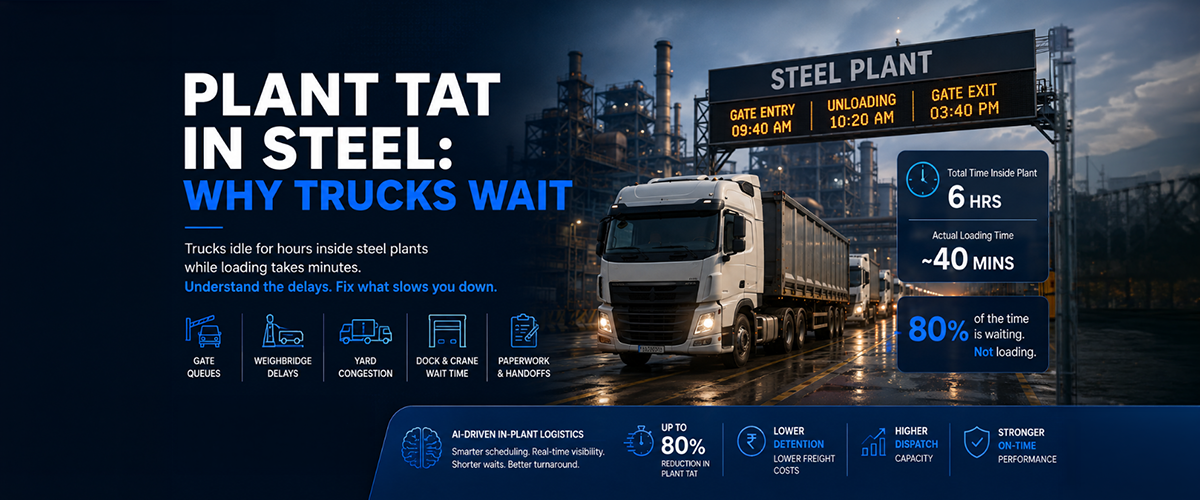
A truck reaches your plant gate at 9:40 in the morning. It leaves at four in the afternoon. Somewhere inside those six hours, roughly forty minutes involved actual loading.
The rest was waiting. Waiting for gate entry to be logged in a register. Waiting behind eleven vehicles at the weighbridge. Waiting in the yard because the bay it was meant for still had yesterday’s consignment on it. Waiting for a crane operator who was finishing something else. Waiting, at the end, for paperwork.
Nobody did anything wrong that day. The gate clerk worked steadily, the crane operator didn’t take a long break, the weighbridge ran all morning. And yet the plant burned five hours of truck time it will never get back, on one vehicle, on an ordinary Tuesday.
That is plant TAT. And in most Indian steel plants, nobody owns it.
In one line: Plant TAT (turnaround time) is the total time a vehicle spends inside a plant from gate entry to gate exit. In steel plants it is usually dominated not by loading but by waiting — at the weighbridge, in the yard, and for dock and crane availability.
Key Takeaways
Plant TAT is the clock that starts when a vehicle enters your gate and stops when it leaves. Not when loading starts. Not when the invoice is raised. Gate to gate.
Most plants track it loosely if at all, usually from the security register, and usually as a monthly average that hides everything interesting. An average of four hours can be a plant where every truck takes four hours, or a plant where half take ninety minutes and half take seven. Those are completely different problems, and only one of them is fixable this quarter.
The number worth watching is not the average. It is the spread, and the reasons behind the long tail.
Documentation checks, driver verification, entry logging. Individually quick. The problem is that arrivals cluster. Nine trucks show up between 9 and 10 because that is when transporters like to dispatch, and the gate becomes a queue before the plant has even started working.
Every loaded vehicle crosses it twice, in and out, and most plants have one. It is the single most contended piece of infrastructure in the yard and it is almost never scheduled. Trucks queue for it the way people queue for a bank counter, which is to say inefficiently and with no visibility into how long the wait will be.
This is where the invisible time accumulates. A vehicle is parked because its bay is occupied, or because the material is still being moved from stockyard to loading point, or because nobody has told anyone it has arrived. Yard time rarely gets recorded anywhere, which is exactly why it grows.
Crane and crew availability, material readiness, lashing and securing for long products or coils. Real work happens here. But if the bay was allocated on a first-come basis rather than by what is actually ready to load, the truck may be sitting in the right place at the wrong time.
Second weighing, invoice, e-way bill, gate pass. A well-run plant does this in fifteen minutes. A plant where the documentation team sits in a different building does not.
Ask a plant head where the time goes and you will get five plausible answers. That is the problem. When the delay is spread thin across five places, no single one of them ever looks bad enough to fix.
The cost people expect is detention, and detention is real. But it is the smaller half of the bill, and often you do not even see it as a line item. Transporters who know your plant runs long simply quote higher. The delay gets priced into your base rate, permanently, and it never appears as a charge you could dispute.
The larger cost is capacity. A truck that spends six hours inside your plant is a truck that does one trip instead of two. Across a transporter’s fleet, that halves the vehicles effectively available to you, which is precisely why placement gets difficult on the days you need it most. Poor TAT does not just cost money. It quietly shrinks your access to trucks.
Then there is the third-order effect nobody attributes back to the yard. Dispatch slips, the customer gets the material a day late, and the reorder goes somewhere else. That cost lands in the sales report, not the logistics one.
Most plants have tried to fix this. The standard playbook is a TAT reduction drive: set a target, put up a board, brief the gate team, chase the worst offenders for a month. TAT drops. Two quarters later it is back.
It comes back because the drive treated the symptom. Everyone worked faster for a while, but the underlying condition never changed, and the underlying condition is this: the plant does not know what is arriving until it arrives.
You cannot sequence a weighbridge for vehicles you cannot see coming. You cannot allocate a bay to a truck whose arrival is a guess. So the plant defaults to first-come-first-served, which is the least efficient scheduling rule available and the only one possible without forward visibility. Everything downstream inherits that constraint.
Reframe it and the solution changes shape. A truck standing in your yard is, nearly always, a prediction failure. Nobody knew it was coming at 9:40, so nobody sequenced the weighbridge for it, staged the material, or held a bay. The waiting is what a plant does instead of planning.
This is where an AI-native TMS earns its place, and it is a genuinely different intervention from a process drive. If the platform knows where every inbound and outbound vehicle is, and can predict when each will actually reach your gate, the plant stops reacting to arrivals and starts scheduling them.
What that looks like in practice is unglamorous and effective. Arrivals get sequenced against predicted ETAs rather than the order trucks happen to reach the gate. Weighbridge slots get planned instead of queued for. Material staging begins before the vehicle arrives rather than after. And when a truck runs late, which it will, the schedule adjusts around it instead of collapsing into a queue.
The plants that fixed TAT did not make anyone work faster. They stopped being surprised.
SP Shipment Tracking gives the plant live visibility of every vehicle heading toward it, so arrivals are known in advance rather than discovered at the gate. SP In-Plant Logistics takes that forward view and turns it into a schedule, tracking each vehicle through gate, weighbridge, yard and loading so the time between stages is measured rather than assumed.
Because every stage is timestamped, the long tail finally becomes visible. You can see that Tuesday mornings clog at the weighbridge, or that one bay runs consistently slower, or that documentation adds forty minutes on days when a particular shift is on. None of that is available from a security register.
And upstream of the gate, SP Indent Allocation shapes what arrives in the first place. Automated reassignment when a transporter refuses or fails to place, and automatic penalty debits on non-performance, mean fewer surprise gaps and fewer bunched arrivals to absorb.
Improved plant TAT
On-time vehicle placement
Faster vehicle finalisation
Enterprise customers
Source: SuperProcure — Metal & Steel Industry, verified performance metrics
Steel and metal companies working with SuperProcure include Shyam Steel, Shyam Metalics, Goodluck, APL Apollo, Hindalco, Sunflag Iron & Steel and Hansa Metallics.
If you do not know your current TAT broken down by stage, that is the first week’s work. Not a target, not a drive. Just the measurement, because you cannot argue with a stage-wise number and you cannot fix an average.
Most plant heads are surprised by what it shows. The bottleneck is rarely where the shouting happens. It is usually somewhere quiet, like the gap between weighbridge and bay allocation, where a truck waits forty minutes because two systems that should be talking to each other are a phone call apart.
Fix the visibility and the scheduling follows. Fix the scheduling and the hours come back.
• SuperProcure — Metal & Steel Industry (platform performance metrics)
• SuperProcure — SP In-Plant Logistics capabilities
• Unified Logistics Interface Platform (ULIP) — official portal
See How SuperProcure Cuts Plant TAT Book a Demo