




Enviropol Engineers Gains Control Over Multi-Site Project Logistics with 93% On-Time Vehicle Placement and 11% Freight Cost Savings
Case Study Enviropol Engineers Gains Control Over Multi-Site Project Logistics with 93% On-Time Vehicle Placement












Case Study Enviropol Engineers Gains Control Over Multi-Site Project Logistics with 93% On-Time Vehicle Placement

Table of Content : Two steel plants of roughly the same size, making roughly the same products, can
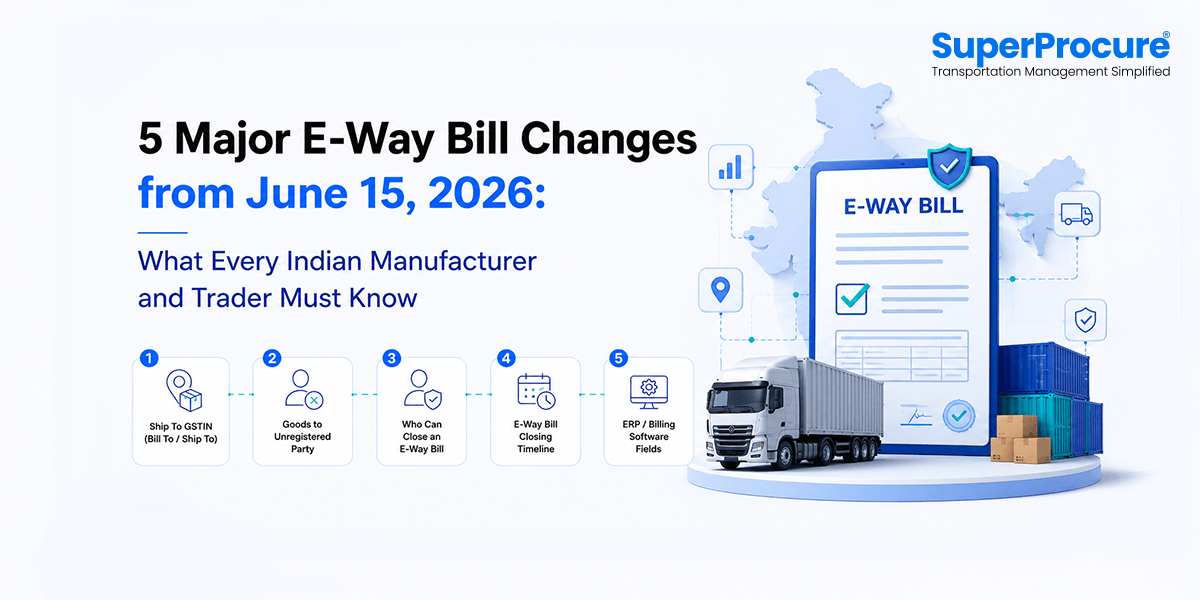
On June 15, 2026, the GST Council’s updated E-Way Bill regulations come into force and if your logistics operations, ERP systems, or transporter workflows are not updated before that date, the consequences are immediate: goods detained at checkposts, E-Way Bills rejected at state borders, and penalties of ₹10,000 or the full tax amount on the consignment, whichever is higher.
These are not minor procedural tweaks. The five changes collectively tighten the E-Way Bill system at both ends of every shipment from the moment a bill is generated to the moment goods are confirmed delivered. The government’s objective is clear: eliminate fake billing, stop ITC fraud, and create an unbroken digital audit trail from supplier to end-consumer.
For Indian manufacturers and traders who move goods across state lines every day, the question is not whether these rules apply to you. They do. The question is whether your logistics operations and your software are ready.
The E-Way Bill system, introduced in 2018, was a significant step in digitizing goods movement under GST. But gaps in the original framework allowed certain practices to persist: goods being delivered to an address different from the registered billing address without disclosure, E-Way Bills being left open long after delivery, and bills being reused across multiple transactions.
The June 15 amendments are designed to close these gaps creating mandatory disclosure of the actual delivery address, time-bound closure obligations, and distributed responsibility for closure, so that the E-Way Bill lifecycle mirrors the physical movement of goods with no room for manipulation.
| What’s Changing | Old Rule | New Rule (from June 15) |
| Ship To GSTIN (Bill To / Ship To) | Only Bill To GSTIN required | Ship To GSTIN now mandatory when goods ship to a different address than billing. |
| Goods to Unregistered Party | No specific code for unregistered buyers | ‘URP’ (Unregistered Person) must be entered in Ship To field when buyer has no GST registration. |
| Who Can Close an E-Way Bill | Only the generator could cancel / close | Supplier, Recipient, Transporter, OR Driver can now close after delivery. |
| E-Way Bill Closing Timeline | No fixed deadline to close | Must be closed on the day of delivery or the next day. |
| ERP / Billing Software Fields | Existing fields sufficient | New fields (Ship To GSTIN, URP) must be added Tally, Zoho, SAP, custom software. |
In a Bill To / Ship To transaction goods billed to one party but delivered to another address the E-Way Bill previously required only the Bill To GSTIN. From June 15, the Ship To GSTIN is also mandatory.
Example: A manufacturer in Pune bills a distributor in Delhi, but goods ship directly to the distributor’s warehouse in Nagpur. Previously only the Delhi GSTIN was required; after June 15, the Nagpur GSTIN must also be entered.
Operationally, your billing team needs the Ship To party’s GSTIN at the time of generation which means a systematic update to your consignee master data in your ERP.
When goods go to a buyer not registered under GST a small retailer, an individual, an end-consumer the Ship To field must now carry the code “URP” (Unregistered Person) instead of a GSTIN.
This targets a known fraud pattern: generating E-Way Bills for registered parties but delivering to unregistered buyers, then claiming ITC without a genuine registered recipient. Guidance for billing teams: if the Ship To party has no GSTIN, enter URP no exceptions.
Previously only the generator could cancel or close. From June 15, any of four parties can close a bill: the Supplier, Recipient, Transporter, or Driver.
The implication: your transporters and drivers need to know this, and need the tools to act. A driver who delivers at 6 PM but doesn’t know they can close the bill on their phone is a compliance liability under the same-day closure rule.
Every E-Way Bill must be closed on the day of delivery or the following day. A bill that remains open after delivery is a compliance gap it signals goods may not have been delivered as recorded, opening the door to scrutiny and penalties.
For companies dispatching hundreds of shipments daily across states, manually tracking closures is impractical. This rule effectively mandates an automated delivery-to-closure workflow.
The new fields Ship To GSTIN and URP must be supported by your billing/ERP software before the rules take effect. Tally, Zoho, SAP, and custom platforms all need updating. Enterprise SAP changes require testing cycles, so start your vendor conversation this week.
The five changes get the headlines but a parallel risk has always existed and is now sharper: E-Way Bills expiring while goods are still in transit.
A transporter estimates travel time and sets an expiry. A Mumbai–Delhi bill might be valid 24 hours. But a weighbridge queue in Rajasthan, a road blockage in UP, or a breakdown can add 8 hours and the bill expires. A truck carrying goods with an expired E-Way Bill can be detained at any checkpost, with the same ₹10,000+ penalty.
Most companies rely on the driver to notice the expiry and call the logistics team. But drivers are focused on driving they do not watch expiry timestamps. By the time someone notices, the bill has expired, and the truck is potentially at a checkpost.
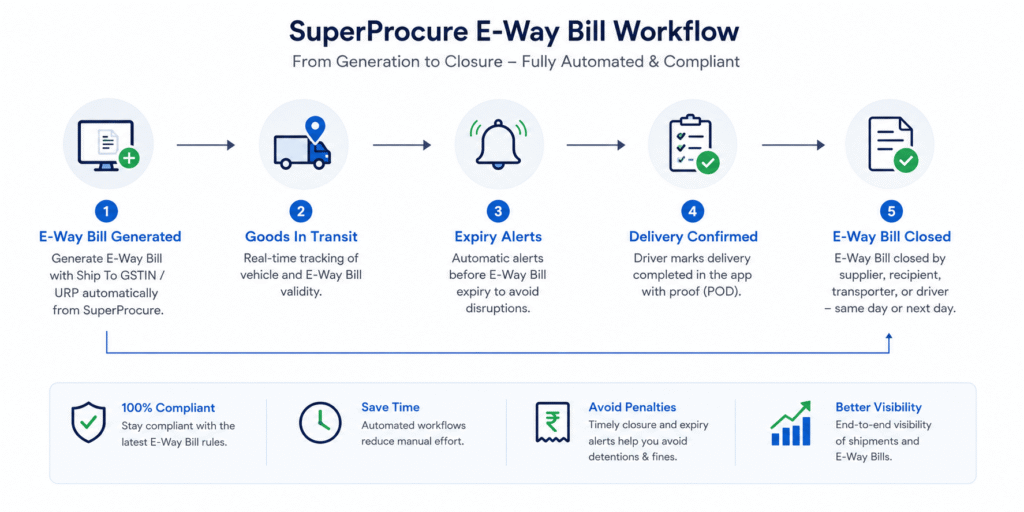
SuperProcure is a next-generation TMS trusted by 300+ Indian enterprises including Tata Chemicals, Havells, ITC, and Afcons. Its platform integrates with government logistics systems including ULIP APIs (FASTag, Vahan, Sarathi) and the NIC E-Way Bill portal.
| New June 15 Requirement | Risk if Not Addressed | How SuperProcure Handles It |
| Ship To GSTIN now mandatory | Goods detained for missing GSTIN field | SP captures Ship To GSTIN at indent stage, linked to consignee master data before the bill is generated. |
| Close same / next day of delivery | Open bills = audit red flag, penalty | SP Shipment Tracking detects delivery (GPS/ePOD) and triggers an automatic closure reminder on delivery day. |
| Anyone can close driver must act | Driver unaware → bill stays open | On the basis of unloading confirmation, the platform can close the E-Way Bill through an API request. |
| E-Way Bill expiry during transit | Expired bill = goods detained, fine | SP’s E-Way Bill Extension feature monitors expiry in real time and alerts before expiry, with direct extension via NIC portal integration. |
When a trip is created in SuperProcure and the vendor generates an E-Way Bill, SP monitors validity in real time. As the expiry window approaches before the bill actually expires SP automatically detects the impending expiry based on the validity window and the shipment’s location and remaining transit time, sends a real-time notification to the vendor, transporter, and logistics team with enough lead time to act, provides direct extension capability through its integration with the NIC E-Way Bill portal, and creates an audit trail of the extension.
Combined with SP Shipment Tracking’s real-time GPS and FASTag integration, SP knows where every truck is, how far it has to go, and when the E-Way Bill needs to be extended — with enough advance notice for action. This runs automatically across every active shipment in your network.
The GST Council’s June 15 changes are not the first tightening of the E-Way Bill framework, and won’t be the last. The direction is clear: India’s goods movement system is becoming progressively more transparent, real-time, and less tolerant of documentation gaps.
The cost of non-compliance is not just the ₹10,000 penalty. It is the detained truck that delays a project deadline, the GST audit triggered by a pattern of open bills, the distributor relationship damaged by a late delivery.
The companies that come through smoothly are the ones building compliance into their logistics process so Ship To GSTINs are captured automatically, closures happen on delivery day, and expiry alerts reach the right person before a truck reaches a checkpost. SuperProcure’s platform already does this.
Make E-Way Bill Compliance Effortless with SuperProcure Book a Demo