


Enviropol Engineers Gains Control Over Multi-Site Project Logistics with 93% On-Time Vehicle Placement and 11% Freight Cost Savings
Case Study Enviropol Engineers Gains Control Over Multi-Site Project Logistics with 93% On-Time Vehicle Placement












Case Study Enviropol Engineers Gains Control Over Multi-Site Project Logistics with 93% On-Time Vehicle Placement
Table of Content : Two steel plants of roughly the same size, making roughly the same products, can
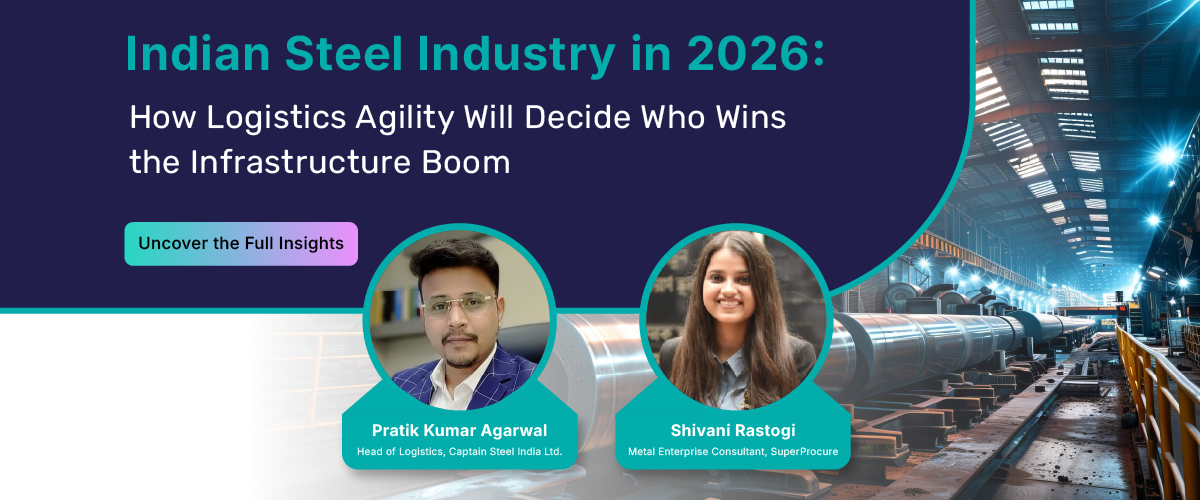
To understand the pressure steel leaders are feeling today, we first need to look at how much the ground has shifted beneath our feet in the last decade.
In 2015, India’s finished steel consumption was roughly 85 Million Tonnes.
Fast forward to 2026, and we are closing in on 140-150 Million Tonnes.
That is nearly double the appetite in just over ten years. But it’s not just the volume that has changed, it’s the source of that demand.
We are seeing a perfect storm of global and local dynamics:
This consumption isn’t happening in a vacuum. It is being driven by the most aggressive infrastructure push in India’s history:
The Verdict: We are making the steel. The country is screaming for it. But here lies the new bottleneck.
We have solved Production. We haven’t solved Placement.
As infrastructure demand accelerates, supply chain agility powered by AI is becoming as critical as production capacity itself. Predictive analytics, AI-driven demand forecasting, and real-time logistics visibility are no longer optional, they are essential to avoid bottlenecks and missed opportunities.
In the 2026 steel market, companies that combine strong production with intelligent, tech-enabled logistics will be the ones that truly scale with speed and confidence.
— Mr. Pratik Kumar Agarwal, Head of Logistics, Captain Steel India Ltd
There is a massive geographical disconnect in the Indian steel sector. Most integrated steel plants are clustered in the mineral-rich belts of Odisha, Jharkhand, and Chhattisgarh. However, the bulk of consumption is happening in the industrial and infrastructure hubs of Maharashtra, Gujarat, and Karnataka.
You rely heavily on Indian Railways to bridge this 1,500km+ gap. But rake availability is often a roll of the dice. When rakes aren’t available, you are forced to switch to road transport, which instantly spikes your freight cost.
Move from “reactive logistics” to Agile Allocation. You need a digitized system that gives you real-time control over your Rail vs. Road mix. If a rake is delayed, you cannot wait for end-of-day reports. You need the data now so you can instantly source trucks and keep the material moving before the client penalty clause kicks in.
We are in a peculiar situation where volume is high, but spreads are tight.
Coking coal prices are volatile due to geopolitical tensions. Cheap imports (dumping) are capping the price you can sell at.
If you can’t control the global coal price, and you can’t control the market selling price, what can you control? Your operational efficiency.
In the Indian steel sector, logistics costs are disproportionately high, often consuming 16-18% of revenue (nearly double the global average).
Digitizing the indent process, automating freight negotiation, and streamlining gate operations typically reduces this logistics spend by 10-12%.
When you cut 10% from a cost base that is 16% of your revenue, you are adding 1.6% directly to your EBITDA. Global benchmarks from BCG support this, showing that steel players who digitize supply chains see EBITDA boosts of 2-4%. In a high-volume game, these “pennies” saved on freight add up to crores in profit.
Ten years ago, an EPC contractor would place an order and wait. Today, site managers at infrastructure projects expect the same visibility for 20 tons of steel that they get for a ₹500 pizza delivery.
The “Black Box.” Once the material leaves the stockyard, the sales team spends half their day answering calls: “Gaadi kahan pahunchi?” (Where has the vehicle reached?). Lack of visibility leads to site stoppages, and a stopped site is a furious customer.
Customer visibility is a retention tool. Providing tracking to your B2B customers creates trust. It signals that you aren’t just a commodity vendor, you are a partner in their project’s timeline.
We need to stop viewing logistics as a back-office ledger and start treating it as a front-office growth engine. In the 2026 infrastructure market, ‘Visibility’ is the new currency of trust.
The goal of digitization isn’t just tactical savings on a spot rate; it’s about capturing the historical intelligence required to predict, control, and optimize costs for the next decade.
— Shivani Rastogi,
Metal Enterprise Consultant, SuperProcure
Building new Blast Furnaces takes years. But optimizing your supply chain can happen in months.
To keep up with India’s construction demand, the steel industry doesn’t just need more capacity; it needs more agility. The winners of this infrastructure boom won’t just be the ones with the biggest plants, they will be the ones who can promise delivery and honor it, regardless of the chaos in between.
Let’s build India, but let’s build our supply chains smart.
| Metric / Trend | Source | Link |
| Consumption Growth (85MT to 140MT) | Ministry of Steel (Annual Report 2023-24) | View Report |
| Highway Construction (12km to 34km/day) | Ministry of Road Transport (Year End Review) | View PIB Release |
| Global Volatility (China Real Estate) | World Steel Association (Short Range Outlook) | View Outlook |
| CBAM & Export Risks | Argus Media / S&P Global | View Analysis |
| Logistics Cost (16-18% of Revenue) | MyMetalogic / ResearchGate | View Industry Analysis |
| EBITDA Impact (2-4% Boost) | Boston Consulting Group (BCG) Case Study | View BCG Report |
| Production Geography (Eastern Cluster) | Ministry of Steel (State-wise Data) | View PIB Data |
Book a Demo of India’s Leading Logistics Tracking Platform Book a Demo